







What Real Material Acts Like Spider-Man’s Webs?

1 / 10 Questions
0 Points

What Real Material Acts Like Spider-Man’s Webs?

Steel

Cotton

Rubber

Plastic

Points won
0
Correct score
0%

More Questions

More Articles

Did You Know These 20 Facts About US Roadside Attractions?

Did You Know These 20 Facts About US Roadside Attractions?

⏱️ 7 min read

America's highways are lined with quirky monuments, bizarre sculptures, and eccentric landmarks that have captured the imagination of travelers for generations. These roadside attractions represent a uniquely American form of folk art and entrepreneurship, transforming ordinary road trips into memorable adventures. From oversized objects to mysterious monuments, these attractions tell the story of American creativity, humor, and the open road culture that defined much of the 20th century.

Fascinating Facts About America's Roadside Wonders

1. The World's Largest Ball of Twine Required Over Four Decades to Create

In Cawker City, Kansas, Frank Stoeber spent 29 years creating a massive ball of twine that weighed 5,000 pounds when he stopped in 1974. The community then took over, and today the ball weighs over 20,000 pounds and measures more than 40 feet in circumference. An annual twine-a-thon event allows visitors to continue adding to this enormous sphere.

2. South of the Border Spans Two States Simultaneously

The famous South of the Border attraction near Dillon, South Carolina, sits so close to the North Carolina border that its 200-foot sombrero tower and sprawling complex essentially straddle two states. This kitschy Mexican-themed rest stop features over 350 billboards spanning 175 miles in both directions, making it one of the most advertised attractions in America.

3. Cadillac Ranch Cars Are Buried at the Same Angle as the Great Pyramid

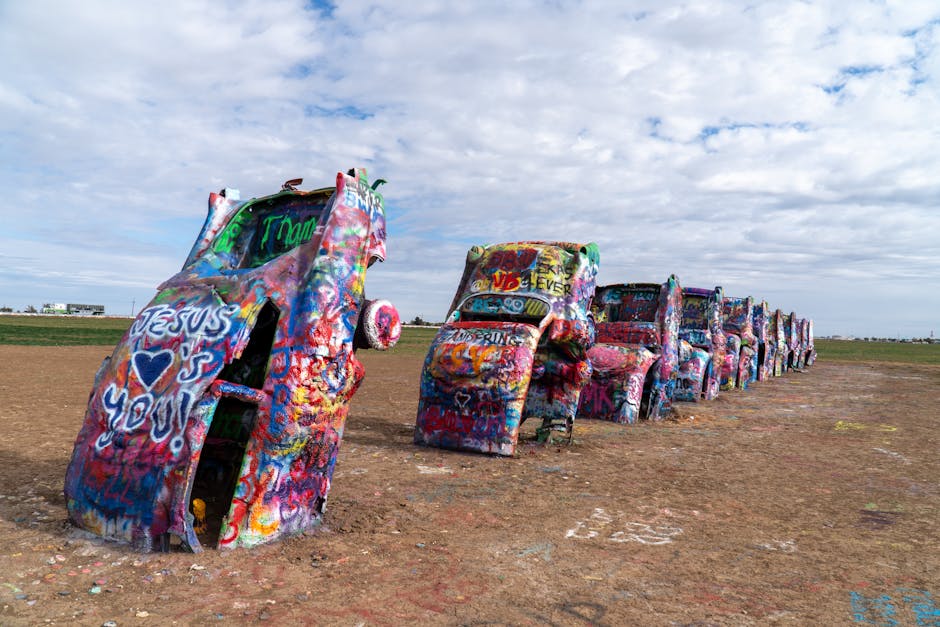
Located in Amarillo, Texas, the ten Cadillacs planted nose-first into the ground are positioned at a 52-degree angle, matching the angle of the Pyramid of Giza. Created by the art collective Ant Farm in 1974, this installation has become an interactive canvas where visitors are encouraged to spray paint the vehicles.

4. Lucy the Elephant Predates the Statue of Liberty

Built in 1881 in Margate City, New Jersey, Lucy the Elephant stands six stories tall and was constructed two years before the Statue of Liberty arrived in America. This architectural folly was originally built as a real estate promotion and has served as a home, business office, and tavern throughout its history.

5. The Mystery Spot Defies Scientific Explanation According to Millions

Opening in 1939 in Santa Cruz, California, The Mystery Spot features a circular area where the laws of physics seemingly don't apply. Visitors experience unusual phenomena including objects rolling uphill and people appearing to change height. While scientists attribute it to optical illusions, the attraction maintains its mysterious reputation.

6. Wall Drug Started with Free Ice Water During the Depression

Wall Drug in Wall, South Dakota, transformed from a struggling pharmacy into a massive tourist complex by offering free ice water to travelers in 1936. Today, the 76,000-square-foot facility still provides free ice water while serving approximately 20,000 visitors daily during peak season.

7. The Original Wigwam Motel Inspired the Cozy Cone in Cars

Built in the 1930s and 1940s, the Wigwam Motels feature concrete teepees that guests can sleep in. The Holbrook, Arizona location directly inspired the Cozy Cone Motel in Pixar's "Cars" movie, bringing renewed attention to this Route 66 classic.

8. Coral Castle Was Built Single-Handedly Using Unknown Methods

Edward Leedskalnin spent 28 years creating Coral Castle in Florida, carving and moving over 1,100 tons of coral rock entirely alone. He worked only at night and left no explanation of how he moved stones weighing several tons each, leading to persistent theories about his construction methods.

9. The Giant Peachoid Water Tower Holds One Million Gallons

Standing 135 feet tall in Gaffney, South Carolina, this water tower was painted to resemble a peach in 1981. The structure holds one million gallons of water and has become such an icon that it was featured in the opening credits of "House of Cards."

10. Carhenge Perfectly Replicates Stonehenge's Dimensions

Built in 1987 near Alliance, Nebraska, Carhenge uses 39 vintage American automobiles to replicate Stonehenge's structure with remarkable accuracy. The monument was created as a memorial and has since been painted gray to more closely resemble the ancient British landmark.

11. The World's Largest Chest of Drawers Was Actually a Furniture Advertisement

High Point, North Carolina, home to the furniture industry, features a building shaped like a giant bureau that stands 38 feet tall. Built in 1926, it originally advertised the High Point Chamber of Commerce and represents the city's furniture manufacturing heritage.

12. Muffler Men Were Mass-Produced Highway Giants

International Fiberglass created approximately 200 twenty-foot-tall fiberglass men in the 1960s, originally designed to advertise muffler shops. These giants were repurposed across America to hold everything from axes to hot dogs, becoming beloved roadside icons.

13. The Thing Remains Arizona's Most Successful Mystery Marketing

Along Interstate 10 in Arizona, hundreds of billboards ask "What is The Thing?" This attraction has successfully maintained curiosity for decades, refusing to reveal its secret in advertising. The mystery has proven so effective that it remains one of the Southwest's most visited roadside stops.

14. Paul Bunyan Statues Number Over Two Hundred Nationwide

The legendary lumberjack appears in giant statue form throughout logging regions, particularly in the Midwest and Pacific Northwest. California, Minnesota, and Michigan each claim to have the "authentic" Paul Bunyan, with statues ranging from 18 to over 30 feet tall.

15. The Blue Whale of Catoosa Was a Anniversary Gift

This 80-foot-long blue whale in Catoosa, Oklahoma, was built by Hugh Davis in the 1970s as an anniversary gift to his wife, who collected whale figurines. It became a beloved swimming hole for local children and remains a cherished Route 66 photo opportunity.

16. Dinosaur Park Sculptures Have Stood Since the Great Depression

Rapid City, South Dakota's Dinosaur Park features seven concrete dinosaurs created in 1936 as a Works Progress Administration project. These Depression-era sculptures have become such icons that they appear on the city's official seal.

17. The World's Largest Collection of Smallest Versions Exists in One Place

Erika Nelson's World's Largest Collection of the World's Smallest Versions of the World's Largest Things is a traveling exhibition showcasing miniature versions of roadside attractions. This meta-collection celebrates American roadside culture through carefully crafted small-scale replicas.

18. Salvation Mountain Required Over 100,000 Gallons of Paint

Leonard Knight spent 28 years creating Salvation Mountain near Niland, California, using adobe clay and over 100,000 gallons of donated paint. This three-story tall folk art installation features biblical verses and has been recognized as a national treasure worthy of preservation.

19. The House on the Rock Contains No Rock House

Despite its name, this Wisconsin attraction, which opened in 1959, features a sprawling complex of bizarre collections including the world's largest carousel. The original house does sit atop a rock formation, but the attraction has grown into a surreal maze of eclectic exhibits.

20. Interstate Highway System Nearly Eliminated Roadside Attractions

The 1956 Interstate Highway Act created high-speed roads that bypassed small towns, threatening the existence of roadside attractions that depended on slower highway traffic. Many attractions closed, but surviving landmarks have experienced renewed interest as travelers seek authentic Americana experiences.

The Enduring Legacy of American Roadside Culture

These twenty facts reveal how roadside attractions represent more than mere curiosities—they embody American ingenuity, humor, and the entrepreneurial spirit. From giant objects to mysterious monuments, these landmarks transformed functional highways into entertainment corridors and gave small communities distinctive identities. While modern GPS and interstate highways have changed how Americans travel, these attractions continue to draw visitors seeking authentic experiences and connections to a slower-paced era. They remind us that the journey itself can be as memorable as the destination, and that sometimes the most remarkable discoveries happen when we take the scenic route.

USA Trivia Challenge: 20 Questions on American History

USA Trivia Challenge: 20 Questions on American History

⏱️ 7 min read

American history is filled with fascinating events, remarkable individuals, and pivotal moments that shaped not only the nation but the entire world. Testing knowledge through trivia challenges offers an engaging way to explore the rich tapestry of the United States' past, from colonial times through modern day. This collection presents twenty thought-provoking questions that span different eras and aspects of American history, designed to challenge enthusiasts and casual history buffs alike.

Colonial America and the Revolutionary Era

The Mayflower's Transatlantic Journey

One of the most iconic voyages in American history occurred in 1620 when the Mayflower carried 102 passengers across the Atlantic Ocean. The question of how long this perilous journey took reveals the hardships faced by early settlers. The voyage lasted approximately 66 days, with passengers enduring cramped conditions, storms, and seasickness before reaching Cape Cod in November 1620, far north of their intended Virginia destination.

The Authorship of the Declaration of Independence

While the Declaration of Independence represents the collective vision of the Continental Congress, its primary author holds special significance in American history. Thomas Jefferson, at just 33 years old, was chosen to draft this revolutionary document. His eloquent words about self-evident truths and unalienable rights would echo through centuries of democratic movements worldwide.

The First American President's Inauguration Location

George Washington took the oath of office as the first President of the United States in New York City, not in the current capital. Federal Hall in New York served as the nation's capital from 1789 to 1790, where Washington was inaugurated on April 30, 1789, establishing precedents that continue to shape the presidency today.

The Louisiana Purchase Price Tag

In 1803, President Thomas Jefferson negotiated one of history's most significant real estate transactions. The United States purchased approximately 827,000 square miles of territory from France for $15 million, effectively doubling the size of the young nation. This translates to roughly three cents per acre, making it one of the greatest land bargains in history.

Civil War and Reconstruction

The Confederate States' Number

Understanding the scope of the Civil War requires knowing that eleven states seceded from the Union to form the Confederate States of America. These states were South Carolina, Mississippi, Florida, Alabama, Georgia, Louisiana, Texas, Virginia, Arkansas, Tennessee, and North Carolina, representing the geographic and ideological division that tore the nation apart from 1861 to 1865.

The Gettysburg Address Duration

Abraham Lincoln's most famous speech, delivered on November 19, 1863, at the dedication of the Soldiers' National Cemetery in Gettysburg, Pennsylvania, lasted only about two minutes. Despite its brevity—just 272 words—this address became one of the most quoted speeches in American history, redefining the Civil War as a struggle for human equality.

The First State to Grant Women's Suffrage

Wyoming Territory made history in 1869 by becoming the first territory to grant women the right to vote and hold office. When Wyoming became a state in 1890, it maintained this right, earning the nickname "The Equality State" and paving the way for the national women's suffrage movement that culminated in the 19th Amendment in 1920.

Modern America and World Wars

America's Entry into World War I

The United States maintained neutrality for most of World War I before entering the conflict in 1917. President Woodrow Wilson asked Congress for a declaration of war against Germany on April 2, 1917, citing unrestricted submarine warfare and the Zimmermann Telegram as key factors that made neutrality impossible to maintain.

The Great Depression's Starting Point

The stock market crash that triggered the Great Depression occurred on October 29, 1929, known as "Black Tuesday." The Dow Jones Industrial Average plummeted, wiping out millions of investors and ushering in a decade of unprecedented economic hardship that affected nearly every American family and fundamentally transformed government's role in the economy.

Pearl Harbor's Date of Infamy

December 7, 1941, marks the surprise military attack by the Imperial Japanese Navy Air Service on the United States naval base at Pearl Harbor, Hawaii. This "date which will live in infamy," as President Franklin D. Roosevelt declared, resulted in America's entry into World War II and changed the course of global history.

The Manhattan Project's Purpose

This top-secret research and development project undertaken during World War II aimed to develop the world's first nuclear weapons. Led by the United States with support from the United Kingdom and Canada, the Manhattan Project employed over 130,000 people and cost nearly $2 billion, culminating in the atomic bombs dropped on Hiroshima and Nagasaki in August 1945.

Civil Rights and Contemporary History

Brown v. Board of Education's Landmark Year

In 1954, the Supreme Court delivered its unanimous decision in Brown v. Board of Education of Topeka, declaring state laws establishing separate public schools for black and white students unconstitutional. This watershed moment in the Civil Rights Movement overturned the "separate but equal" doctrine established in Plessy v. Ferguson (1896) and sparked the integration of American schools.

The Montgomery Bus Boycott Leader

While Rosa Parks' refusal to give up her seat sparked the movement, Dr. Martin Luther King Jr. emerged as the leader of the Montgomery Bus Boycott that began on December 5, 1955. This 381-day protest against segregated seating on public buses in Montgomery, Alabama, catapulted King to national prominence and demonstrated the power of nonviolent resistance.

The First Moon Landing Date

On July 20, 1969, NASA's Apollo 11 mission successfully landed the first humans on the Moon. Astronauts Neil Armstrong and Buzz Aldrin walked on the lunar surface while Michael Collins orbited above, fulfilling President John F. Kennedy's goal of landing a man on the Moon before the decade's end and winning the Space Race against the Soviet Union.

Watergate Scandal's Resolution

The political scandal that began with a break-in at the Democratic National Committee headquarters at the Watergate complex in 1972 ultimately led to President Richard Nixon's resignation on August 9, 1974. He became the first and only U.S. president to resign from office, facing near-certain impeachment for obstruction of justice and abuse of power.

Constitutional Milestones

The Number of Constitutional Amendments

The U.S. Constitution has been amended twenty-seven times since its ratification in 1788. The first ten amendments, known as the Bill of Rights, were ratified in 1791. These amendments demonstrate the document's flexibility and the nation's ability to adapt to changing circumstances while maintaining fundamental governing principles.

Presidential Term Limits Establishment

The 22nd Amendment, ratified in 1951, established that no person shall be elected to the office of President more than twice. This amendment was passed in response to Franklin D. Roosevelt's unprecedented four-term presidency and formalized the two-term tradition established by George Washington.

Economic and Social Developments

The New Deal's Architect

President Franklin D. Roosevelt introduced the New Deal, a series of programs and reforms designed to combat the Great Depression, beginning in 1933. This comprehensive approach to economic recovery included programs like Social Security, the Works Progress Administration, and the Tennessee Valley Authority, fundamentally reshaping the relationship between the federal government and American citizens.

The Interstate Highway System's Creation

President Dwight D. Eisenhower signed the Federal-Aid Highway Act in 1956, authorizing the construction of 41,000 miles of interstate highways. This massive infrastructure project, inspired by Eisenhower's experience with German autobahns during World War II, transformed American commerce, travel, and settlement patterns over subsequent decades.

The September 11 Attacks' Impact

The terrorist attacks on September 11, 2001, killed nearly 3,000 people and prompted profound changes in American foreign policy, national security, and daily life. The attacks led to the War on Terror, the creation of the Department of Homeland Security, and military interventions in Afghanistan and Iraq, reshaping American domestic and international policy for the 21st century.

Conclusion

These twenty questions encompass pivotal moments, decisions, and figures that defined American history from colonial settlement through the modern era. Understanding these historical touchstones provides essential context for comprehending how the United States evolved into its current form. Whether used for educational purposes, entertainment, or friendly competition, trivia challenges offer an accessible entry point into deeper historical exploration. Each question represents not just a factual answer but a gateway to understanding broader themes of democracy, equality, progress, and the ongoing American experiment in self-governance. By engaging with these historical questions, individuals can better appreciate the complex forces and remarkable individuals who shaped the nation's trajectory and continue to influence contemporary American society.