
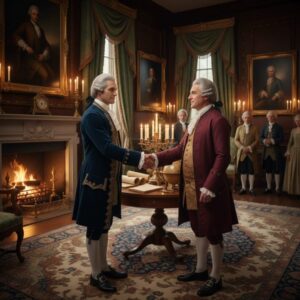








Which US president created the modern handshake?

1 / 10 Questions
0 Points

Which US president created the modern handshake?

George Washington

Theodore Roosevelt

Thomas Jefferson

Abraham Lincoln

Points won
0
Correct score
0%

More Questions

More Articles

Top 12 Fascinating Facts About American Bridges

Top 12 Fascinating Facts About American Bridges

⏱️ 4 min read

Top 12 Fascinating Facts About American Bridges

American bridges represent remarkable feats of engineering and stand as testaments to human innovation and determination. From coast to coast, these architectural marvels have shaped transportation, commerce, and cultural development throughout the nation's history. Here are twelve fascinating facts about American bridges that showcase their significance and unique characteristics.

1. Golden Gate Bridge's True Color

Contrary to what its name suggests, the Golden Gate Bridge isn't golden at all. Its distinctive color is officially called "International Orange." This specific shade was chosen to enhance the bridge's visibility in San Francisco's frequent fog conditions and to complement the natural surroundings while providing protection against corrosion.

2. Brooklyn Bridge's Hidden Wine Cellar

During the Cold War era, the Brooklyn Bridge housed a secret wine cellar in its foundations. Built into the bridge's Manhattan-side tower, these vaulted chambers were rented to liquor dealers and restaurants until 1930. Today, these spaces are used for bridge maintenance storage but remain a fascinating piece of architectural history.

3. Longest Suspension Bridge in the Americas

The Verrazano-Narrows Bridge in New York City holds the title of the longest suspension bridge in the Americas, with a main span of 4,260 feet. When it opened in 1964, it was the longest suspension bridge in the world, though it has since been surpassed by bridges in Asia.

4. Tacoma Narrows Bridge Collapse

The 1940 collapse of the original Tacoma Narrows Bridge in Washington State revolutionized bridge engineering. Nicknamed "Galloping Gertie," the bridge's dramatic oscillations and eventual collapse due to aeroelastic flutter led to fundamental changes in how engineers approach bridge design, particularly regarding wind effects.

5. First Steel Wire Suspension Bridge

The John A. Roebling Suspension Bridge, connecting Cincinnati, Ohio, to Covington, Kentucky, was the first steel wire suspension bridge in North America. Completed in 1866, it served as the prototype for Roebling's later and more famous Brooklyn Bridge.

6. Chesapeake Bay Bridge-Tunnel's Unique Design

The Chesapeake Bay Bridge-Tunnel combines two bridge spans and two tunnels, creating a 23-mile-long structure that connects Virginia's eastern shore with the mainland. This engineering marvel includes artificial islands that enable the transition between bridges and tunnels.

7. Mackinac Bridge's Flexibility

Michigan's Mackinac Bridge, connecting the state's upper and lower peninsulas, is designed to sway up to 35 feet side-to-side at its center span to accommodate high winds. This flexibility is crucial for the bridge's survival in the harsh weather conditions of the Straits of Mackinac.

8. Royal Gorge Bridge's Historic Height Record

Colorado's Royal Gorge Bridge held the record for the world's highest bridge from 1929 until 2001, suspended 956 feet above the Arkansas River. While no longer the highest, it remains the highest bridge in the United States and continues to attract thousands of visitors annually.

9. Lake Pontchartrain Causeway's Length

The Lake Pontchartrain Causeway in Louisiana consists of two parallel bridges stretching nearly 24 miles across Lake Pontchartrain. It held the Guinness World Record for the longest bridge over water (continuous) until 2011, when China's Jiaozhou Bay Bridge claimed the title.

10. San Francisco-Oakland Bay Bridge's Lights

The western span of the San Francisco-Oakland Bay Bridge features an impressive light installation called "The Bay Lights," consisting of 25,000 white LED lights that create a dynamic display visible from miles away. This art installation has become a permanent fixture of San Francisco's nighttime skyline.

11. Manhattan Bridge's Subway Impact

The Manhattan Bridge in New York City experiences a noticeable shift in position when subway trains cross it. The bridge's design allows it to lean slightly toward the side carrying more train traffic, demonstrating the complex engineering required to accommodate both vehicular and rail traffic.

12. Bixby Creek Bridge's Hollywood Fame

California's Bixby Creek Bridge, completed in 1932, has become one of the most photographed bridges in the United States. Its dramatic setting along the Big Sur coastline has made it a favorite location for car commercials, movies, and television shows, contributing to its iconic status.

Conclusion

These twelve fascinating facts about American bridges demonstrate the incredible engineering achievements, historical significance, and cultural impact of these structures. From revolutionary designs and record-breaking spans to hidden chambers and artistic installations, American bridges continue to capture imaginations and serve as vital links in the nation's infrastructure. Their stories reflect not only technological advancement but also the human determination to connect communities and overcome natural obstacles.
Ultimate Trivia on America’s Moon Landing and Space Race

Ultimate Trivia on America’s Moon Landing and Space Race

⏱️ 4 min read

Ultimate Trivia on America's Moon Landing and Space Race

The Space Race between the United States and the Soviet Union marked one of the most fascinating periods in human history, culminating in the historic Apollo 11 moon landing. This comprehensive collection of trivia reveals lesser-known facts and intriguing details about this remarkable achievement and the competition that drove it.

Origins of the Space Race

The Space Race officially began on October 4, 1957, when the Soviet Union successfully launched Sputnik 1, the world's first artificial satellite. This achievement sent shockwaves through the American scientific and military communities, leading to the creation of NASA in 1958 and President Kennedy's famous moon landing commitment in 1961.

  • The Soviet Union maintained early dominance in space achievements, including the first human in space (Yuri Gagarin, 1961)
  • The term "Space Race" was coined by journalists in the 1950s
  • NASA's budget peaked at 4.41% of the federal budget in 1966
  • The entire Space Race cost the U.S. approximately $28 billion (1960s dollars)

Apollo Program Fascinating Facts

The Apollo program, spanning from 1961 to 1972, represented the largest peaceful mobilization of resources and manpower in American history. Here are some remarkable details about the program:

  • More than 400,000 people worked on the Apollo program
  • The Apollo Guidance Computer had less processing power than a modern calculator
  • The Saturn V rocket remains the most powerful rocket ever successfully launched
  • Each spacesuit cost approximately $670,000 in 1969 dollars
  • The program used more than 15 million engineering drawings

Apollo 11 Mission Details

The Apollo 11 mission, which achieved the first moon landing, was filled with numerous interesting details that often go unmentioned in general historical accounts:

  • The Eagle lunar module had only 20 seconds of fuel remaining when it landed
  • Armstrong and Aldrin left behind over 100 items on the moon, including their boots
  • The famous American flag was purchased at a local Sears store for $5.50
  • The astronauts had to sign customs declarations upon returning to Earth
  • Neil Armstrong's first step onto the lunar surface was taken with his left foot

Technical Achievements and Innovations

The Space Race led to numerous technological breakthroughs that continue to influence modern life. Many everyday items can trace their origins to space program research and development:

  • Memory foam was developed for aircraft seat cushioning
  • Scratch-resistant lenses were created for astronaut helmets
  • Cordless tools were invented for space missions
  • Water filtration systems were developed for spacecraft
  • Modern smoke detectors evolved from NASA technology

Lesser-Known Mission Facts

Several interesting details about the Apollo missions remain relatively unknown to the general public:

  • Astronauts used special Fisher Space Pens that could write in zero gravity
  • The Apollo missions brought back 842 pounds of moon rocks
  • Buzz Aldrin took communion on the moon
  • The Apollo 11 crew was quarantined for 21 days after returning to Earth
  • The mission patches were designed by the crews themselves

Post-Landing Impact

The successful moon landing had far-reaching effects beyond the immediate scientific achievement:

  • An estimated 600 million people worldwide watched the moon landing
  • The event inspired a generation of scientists and engineers
  • Global cooperation in space exploration increased significantly
  • The technology developed led to numerous civilian applications
  • The achievement remains a source of national pride and inspiration

Legacy and Modern Space Exploration

The Space Race's legacy continues to influence modern space exploration and scientific advancement:

  • The International Space Station represents global cooperation in space
  • Private companies now play a significant role in space exploration
  • NASA's Artemis program aims to return humans to the moon
  • Space technology continues to advance at an unprecedented rate
  • The original moon landing sites are protected as historical landmarks

The Space Race and moon landing represent watershed moments in human history, demonstrating humanity's ability to achieve seemingly impossible goals through determination, innovation, and collaboration. The technical and scientific achievements of this era continue to influence modern space exploration and technological development, while the spirit of discovery and achievement remains an inspiration for future generations.

As humanity looks toward future space exploration goals, including missions to Mars and beyond, the lessons and achievements of the Space Race era provide valuable insights and inspiration for overcoming new challenges and reaching even greater heights in space exploration.