








⏱️ 6 min read
The United States is a vast nation filled with geographic peculiarities that often surprise even lifelong residents. From bizarre borders to unexpected natural phenomena, the fifty states contain countless oddities that challenge our assumptions about American geography. These unusual facts reveal a complex tapestry of geological wonders, historical accidents, and administrative curiosities that make the American landscape endlessly fascinating.
Unexpected Geographic Anomalies Across America
Alaska's Mind-Boggling Scale
Alaska isn't just the largest state—it's so massive that if you cut it in half, Texas would become the third-largest state. With 665,384 square miles, Alaska contains more land area than the 22 smallest states combined. The state stretches so far that its Aleutian Islands actually cross into the Eastern Hemisphere, making Alaska simultaneously the northernmost, westernmost, and easternmost state in the nation.
Kentucky's Non-Contiguous Territory
Kentucky Bend, also known as Bubbleland, is a small exclave of Kentucky completely surrounded by Missouri and Tennessee. This 17-square-mile peninsula was created when the Mississippi River changed course after the 1812 New Madrid earthquake, leaving this patch of Kentucky accessible only by traveling through Tennessee. Residents must drive through two other states just to reach the rest of Kentucky.
The Four Corners Monument Mystery
The only place in America where four states meet at a single point—Utah, Colorado, Arizona, and New Mexico—is actually slightly misplaced. The monument sits about 1,800 feet east of where it should be according to the original survey plans. However, the official boundary is wherever the monument stands, making the "mistake" legally irrelevant.
Hawaii's Southernmost Reach
While most Americans think of Florida as the southernmost state, Hawaii's Ka Lae (South Point) on the Big Island extends to 18.9 degrees north latitude, far south of Key West, Florida. This makes Hawaii not only the southernmost state but also home to the southernmost point in the entire United States.
Minnesota's Northwest Angle
The Northwest Angle is a geographic oddity that makes Minnesota the northernmost state in the contiguous U.S. This 123-square-mile peninsula is separated from the rest of Minnesota by the Lake of the Woods and can only be reached by land through Canada. The anomaly resulted from a mapping error in the 1783 Treaty of Paris.
Rhode Island's Deceptive Name
Despite being the smallest state at just 1,214 square miles, Rhode Island's official name is "State of Rhode Island and Providence Plantations"—one of the longest state names. Additionally, the largest city, Providence, isn't on Rhode Island proper; the actual Rhode Island (Aquidneck Island) holds the cities of Newport, Middletown, and Portsmouth.
Michigan's Two Separate Peninsulas
Michigan is the only state divided into two large, distinct peninsulas separated by water. The Upper Peninsula was originally part of Wisconsin Territory but was given to Michigan in 1837 as compensation for Toledo, which went to Ohio. Today, the two peninsulas are connected by the five-mile-long Mackinac Bridge.
Delaware's Circular Border
The northern border between Delaware and Pennsylvania features a perfectly round curve—the only circular state boundary in America. Known as the Twelve-Mile Circle, it was surveyed in 1701 as an arc twelve miles from the courthouse in New Castle, Delaware, creating this unique geometric border.
West Virginia's Panhandle Collection
West Virginia has not one but two panhandles extending from its main body. The Northern Panhandle stretches between Ohio and Pennsylvania, while the Eastern Panhandle extends between Virginia and Maryland. At one point, the Northern Panhandle narrows to just four miles wide.
Florida's Fresh Water Underground Ocean
Beneath Florida lies the Floridan Aquifer, one of the world's most productive aquifers, holding more fresh water than all of the state's surface lakes and rivers combined. This underground reservoir extends beneath southern Alabama, Georgia, and South Carolina, containing quadrillions of gallons of water.
Surprising State Extremes and Superlatives
Maine's Unique Position
Maine is the only state that borders exactly one other state (New Hampshire). It's also the closest U.S. state to Africa, with the distance from Quoddy Head, Maine, to El Beddouza, Morocco, measuring approximately 3,154 miles across the Atlantic Ocean.
Nebraska's Relocated Capital
Nebraska is the only state in the Union that has a unicameral (single-chamber) legislature, but equally quirky is that its capital, Lincoln, was originally called Lancaster. The name was changed in 1867 to honor President Abraham Lincoln, despite Lincoln having never visited Nebraska.
Nevada's Predominant Federal Ownership
The federal government owns approximately 84.9% of Nevada's land, more than any other state. This means private citizens, state government, and local entities control less than 16% of Nevada's territory, with most federal land managed by the Bureau of Land Management and the U.S. Forest Service.
Virginia's Tri-State Water Border
At the geographic point where Virginia, Kentucky, and Tennessee meet, the borders converge not on land but underwater in the Cumberland Gap area. This makes it theoretically possible to swim through three states in a matter of seconds in certain locations.
Colorado's Rectangle Illusion
Despite appearing rectangular on maps, Colorado actually has 697 sides due to 697 survey markers placed during its border demarcation. The state's borders also don't form perfect straight lines; they contain slight curves and deviations caused by 19th-century surveying limitations.
California's Below-Sea-Level Desert
Death Valley in California contains Badwater Basin, the lowest point in North America at 282 feet below sea level. Remarkably, this depression is only 85 miles from Mount Whitney, the highest point in the contiguous United States at 14,505 feet, creating an elevation difference of nearly three miles.
Louisiana's Disappearing Coastline
Louisiana loses approximately one football field worth of land every 100 minutes to coastal erosion and subsidence. The state has already lost nearly 2,000 square miles of land since the 1930s, fundamentally reshaping its geography and threatening entire communities.
Montana's Continental Divide Watershed
Montana is the only state where water flows to three different oceans. The Continental Divide runs through the state, with rivers flowing to the Pacific Ocean, the Gulf of Mexico (Atlantic Ocean), and via the Saskatchewan River system to Hudson Bay (Arctic Ocean) at the rare Triple Divide Peak.
New Jersey's Density Record
New Jersey holds the distinction of being America's most densely populated state, with approximately 1,207 people per square mile. Despite this density, the state has designated 1.4 million acres as preserved farmland and open space, representing about 30% of its total area.
Tennessee's Unexpected Border Bend
The Tennessee-North Carolina border was surveyed incorrectly in 1799, placing the border south of where it should have been. This error inadvertently placed several springs that were supposed to be in North Carolina into Tennessee, including the sources of important water supplies that influenced settlement patterns for decades.
Conclusion
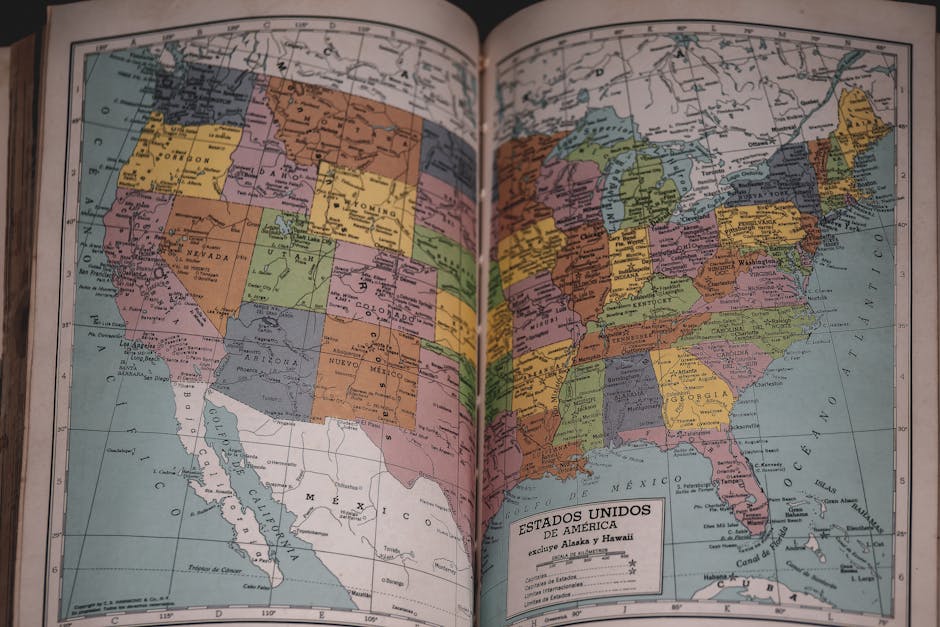
These twenty geographic quirks demonstrate that American state boundaries and landscapes are far more complex than they appear on simplified maps. From territorial exclaves and surveying errors to extreme elevations and unique natural features, each oddity tells a story of geological forces, historical decisions, and cartographic challenges. These peculiarities remind us that geography is never static or simple—it's a dynamic interplay of natural processes and human decisions that continues to shape how we understand and inhabit our nation. Whether caused by ancient earthquakes, diplomatic negotiations, or simple miscalculations, these geographic curiosities make the United States an endlessly intriguing subject for exploration and study.