
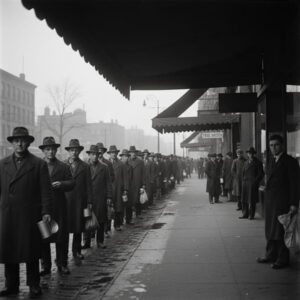









Which board game was commercialized by an unemployed man during the Great Depression?

1 / 10 Questions
0 Points

Which board game was commercialized by an unemployed man during the Great Depression?

Monopoly

Scrabble

Clue

Risk

Points won
0
Correct score
0%

More Questions

More Articles

USA Historical Trivia: 15 Facts About the Great Migration

USA Historical Trivia: 15 Facts About the Great Migration

⏱️ 4 min read

USA Historical Trivia: 15 Facts About the Great Migration

The Great Migration stands as one of the most significant demographic shifts in American history, occurring primarily between 1916 and 1970. During this period, approximately six million African Americans moved from the rural South to urban areas in the North, Midwest, and West. Here are 15 fascinating facts about this transformative period in American history.

1. Timeline and Waves

The Great Migration occurred in two distinct waves. The First Great Migration (1916-1940) saw about 1.6 million people move north, while the Second Great Migration (1940-1970) involved approximately 5 million people. The second wave included destinations in the West, particularly California.

2. Economic Catalyst

World War I served as a major catalyst for the Great Migration. The war created labor shortages in northern factories as military production increased, opening unprecedented job opportunities for African American workers who previously faced limited options in the South.

3. Agricultural Crisis

The boll weevil infestation of the 1910s devastated southern cotton crops, destroying many sharecroppers' and farmers' livelihoods. This agricultural crisis pushed many African Americans to seek opportunities elsewhere, contributing significantly to the migration movement.

4. Railroad Routes

The Illinois Central Railroad, which ran from New Orleans to Chicago, became known as the "Black Migration Highway." Many migrants followed three main routes: the eastern seaboard line to New York and Philadelphia, the midwest route to Cleveland and Detroit, and the western route to California.

5. Cultural Impact

The Great Migration led to the Harlem Renaissance, a flowering of African American artistic and cultural expression in the 1920s. This movement produced influential figures like Langston Hughes, Zora Neale Hurston, and Louis Armstrong.

6. Industrial Employment

Major industries such as meatpacking in Chicago, automobile manufacturing in Detroit, and steel production in Pittsburgh actively recruited African American workers from the South, often offering free transportation and housing.

7. Chicago's Transformation

Chicago's African American population grew from 44,000 in 1910 to 278,000 in 1940. The city's South Side became a major cultural center, giving rise to new forms of blues music and other cultural innovations.

8. Communication Networks

The Chicago Defender, an African American newspaper, played a crucial role in the migration by publishing job listings and train schedules, and encouraging southerners to move north. It was distributed throughout the South despite attempts to suppress it.

9. Housing Patterns

Residential segregation in northern cities led to the creation of distinct African American neighborhoods. While these areas often faced overcrowding and poor conditions, they also became centers of Black entrepreneurship and community life.

10. Educational Opportunities

Access to better educational opportunities was a major draw for migrants. Northern schools were generally better funded and offered more months of instruction compared to the segregated schools of the South.

11. Political Impact

The Great Migration significantly altered American political dynamics. African Americans gained more political power in northern cities, leading to the election of the first Black congressmen from northern states and increased civil rights advocacy.

12. Women's Roles

African American women found new employment opportunities in the North, particularly in domestic service and, during World War II, in manufacturing. Many women were often the first in their families to migrate, establishing footholds for others to follow.

13. Social Organizations

Mutual aid societies, churches, and social organizations helped newcomers adjust to urban life. The Urban League, founded in 1910, specifically helped migrants find housing and employment in northern cities.

14. Population Shifts

By 1970, 47% of African Americans lived in the North and West, compared to only 10% in 1900. This dramatic demographic shift transformed both the regions they left and the cities they adopted as new homes.

15. Cultural Legacy

The Great Migration's impact continues to influence American society today through music, literature, art, and family histories. It helped shape modern urban culture and contributed to the civil rights movement of the 1950s and 1960s.

Conclusion

The Great Migration represents one of the largest internal movements of people in American history. These 15 facts highlight how this massive demographic shift transformed American society, culture, and politics. Its effects continue to influence contemporary discussions about race, urban development, and social justice in the United States. Understanding this crucial period helps explain many aspects of modern American society and the ongoing evolution of race relations in the country.

Ultimate Trivia on Global Explorations and Discoveries

Ultimate Trivia on Global Explorations and Discoveries

⏱️ 5 min read

The history of global exploration represents one of humanity's most ambitious endeavors, fundamentally reshaping our understanding of the world and connecting distant civilizations. From ancient mariners navigating by stars to modern expeditions reaching the deepest ocean trenches, explorers have pushed the boundaries of human knowledge and capability. This journey through time reveals fascinating facts and lesser-known details about the discoveries that changed the course of human history.

Ancient Navigators and Early Maritime Discoveries

Long before Columbus set sail, ancient civilizations were already undertaking remarkable voyages. The Polynesians, arguably the world's greatest early navigators, colonized islands across the vast Pacific Ocean between 3000 BCE and 1000 CE. Using sophisticated wayfinding techniques that read ocean swells, star positions, and bird flight patterns, they traveled thousands of miles in double-hulled canoes without modern instruments. Their discovery and settlement of Hawaii, Easter Island, and New Zealand represent extraordinary feats of exploration that remain impressive by today's standards.

The Phoenicians, master sailors of the Mediterranean, circumnavigated Africa around 600 BCE under the sponsorship of Egyptian Pharaoh Necho II. According to the Greek historian Herodotus, these sailors reported that the sun appeared on their right side while sailing westward around the southern tip of Africa—a detail that actually confirms the authenticity of their claim, as this phenomenon only occurs in the Southern Hemisphere.

The Age of Discovery: Separating Myth from Reality

Christopher Columbus's 1492 voyage remains one of history's most discussed explorations, yet several misconceptions persist. Contrary to popular belief, educated Europeans already knew the Earth was round. Columbus's controversial calculation was his underestimation of Earth's circumference, believing Asia was much closer than it actually was. Had the Americas not existed where they did, his expedition would have perished long before reaching Asia.

Ferdinand Magellan's expedition achieved the first circumnavigation of the globe, but Magellan himself never completed the journey. He was killed in the Philippines in 1521 during the Battle of Mactan. Only 18 of the original 270 crew members returned to Spain in 1522 under the command of Juan Sebastián Elcano, completing a voyage that took nearly three years.

Notable Facts About Age of Discovery Expeditions

  • Vasco da Gama's 1498 voyage to India opened the first direct maritime route from Europe to Asia, forever changing global trade patterns
  • Amerigo Vespucci's detailed letters and maps of the South American coast led cartographers to name the continents after him rather than Columbus
  • The Treaty of Tordesillas in 1494 divided the non-European world between Spain and Portugal, with Pope Alexander VI's blessing
  • Francis Drake's circumnavigation (1577-1580) made England a formidable naval power and brought him a knighthood from Queen Elizabeth I

Exploring the Uncharted Continents

The exploration of Africa's interior remained one of geography's greatest challenges well into the 19th century. While coastal regions were mapped relatively early, the continent's interior was largely unknown to Europeans until the Victorian era. David Livingstone's expeditions between 1841 and 1873 mapped vast regions of central and southern Africa, though his search for the Nile's source proved elusive. The famous meeting between Livingstone and journalist Henry Morton Stanley in 1871 near Lake Tanganyika produced the legendary greeting, "Dr. Livingstone, I presume?"

Antarctica, Earth's final frontier for continental exploration, wasn't confirmed as a continent until the early 19th century. The race to reach the South Pole culminated in 1911 when Norwegian explorer Roald Amundsen's team arrived on December 14, beating Robert Falcon Scott's British expedition by 34 days. Tragically, Scott and his four companions perished on their return journey, just eleven miles from a supply depot.

Scientific Expeditions That Transformed Understanding

Not all explorations sought new lands—some pursued scientific knowledge. Charles Darwin's voyage aboard HMS Beagle (1831-1836) fundamentally changed biology. His observations in the Galápagos Islands, where finches had evolved different beak shapes suited to their food sources, provided crucial evidence for his theory of evolution by natural selection.

Alexander von Humboldt's South American expedition (1799-1804) established modern geography and ecology. Humboldt meticulously documented relationships between climate, geography, and plant distribution, introducing the concept of vegetation zones determined by altitude and latitude. His work influenced countless scientists and remains foundational to environmental science.

Pioneering the Extreme Frontiers

The 20th century shifted exploration to extreme environments. Jacques Piccard and Don Walsh descended to the Challenger Deep in the Mariana Trench in 1960, reaching a depth of 35,814 feet—the deepest point in Earth's oceans. They observed life even at these crushing depths, proving that life could exist in the most extreme conditions.

Mount Everest's summit, first reached by Edmund Hillary and Tenzing Norgay in 1953, represented humanity's conquest of Earth's highest peak. Less celebrated but equally important were Junko Tabei's achievement as the first woman to summit Everest in 1975 and Reinhold Messner's first ascent without supplemental oxygen in 1978.

Legacy and Continuing Exploration

Modern exploration has turned to space and the microscopic world, yet Earth still holds secrets. Ocean floors remain less mapped than Mars's surface, and remote jungles continue yielding new species. The spirit of exploration that drove ancient Polynesians across the Pacific and prompted Victorian adventurers to map Africa's rivers continues today, refined by technology but unchanged in its fundamental human curiosity about the unknown.