


What Profit Margin Does Theater Popcorn Bring?

1 / 10 Questions
0 Points

What Profit Margin Does Theater Popcorn Bring?

40-50%

100-120%

80-90%

20-30%

Points won
0
Correct score
0%

More Questions

More Articles

Top 10 Quirky Festivals From Unexpected Places

Top 10 Quirky Festivals From Unexpected Places

⏱️ 4 min read

Top 10 Quirky Festivals From Unexpected Places

While many are familiar with popular festivals like Carnival in Rio or Oktoberfest in Munich, the world is home to numerous unique and eccentric celebrations that often fly under the radar. These lesser-known festivals showcase the diversity of human culture and creativity, often emerging from unexpected locations. Here are ten of the most peculiar festivals from around the globe that demonstrate how communities come together in remarkably unusual ways.

1. Wife Carrying World Championships - Sonkajärvi, Finland

This bizarre competition, held annually in July, sees male competitors carry female partners through an obstacle course. The prize? The wife's weight in beer. Originating from local folklore about a brigand who tested potential recruits through their ability to carry off village women, the event now attracts participants from around the world. Competitors must navigate a 253.5-meter track featuring water obstacles and various barriers.

2. Monkey Buffet Festival - Lopburi, Thailand

Every November, the ancient city of Lopburi hosts a feast for its local macaque population. More than 2,000 kg of fruits, vegetables, and desserts are carefully arranged on tables throughout the city for thousands of monkeys. This unusual celebration began as a tourism initiative but has become a beloved tradition that honors the cultural significance of monkeys in Thai society.

3. El Colacho (Baby Jumping Festival) - Castrillo de Murcia, Spain

Dating back to 1620, this Catholic festival features men dressed as devils jumping over babies lying on mattresses in the street. The ritual is believed to cleanse the babies of original sin and protect them from illness and evil spirits. Despite its apparent dangers, no injuries have ever been reported during this centuries-old tradition.

4. Boryeong Mud Festival - South Korea

What began as a marketing campaign for locally produced cosmetic mud has evolved into one of South Korea's most popular festivals. Held each July, visitors participate in mud wrestling, mud sliding, and mud beauty treatments. The event attracts over two million visitors annually to the otherwise quiet coastal town of Boryeong.

5. Tunarama Festival - Port Lincoln, Australia

This unique celebration centers around a tuna-throwing competition, where participants compete to throw a frozen tuna fish as far as possible. The festival originated in 1962 to celebrate the local tuna fishing industry. Current record holders have managed to throw these frozen fish over 37 meters. The event also features seafood cooking competitions and local craft exhibitions.

6. Frozen Dead Guy Days - Nederland, Colorado, USA

This three-day festival celebrates the story of Bredo Morstoel, whose cryogenically frozen body has been stored in a Tuff Shed above the town since 1989. Activities include coffin racing, frozen T-shirt contests, and "Frozen Dead Guy" lookalike competitions. The festival has become a quirky tribute to the intersection of death, ice, and celebration.

7. Night of the Radishes - Oaxaca, Mexico

On December 23rd, artisans gather to showcase elaborate sculptures carved from oversized radishes. The tradition began in 1897 when local farmers would carve radishes to attract customers' attention at the Christmas market. Today, the competition features intricate scenes depicting historical events, religious figures, and architectural landmarks, all carved from these root vegetables.

8. Cooper's Hill Cheese Rolling - Gloucestershire, England

Participants chase a 9-pound wheel of Double Gloucester cheese down a nearly vertical 200-yard hill. The first person to cross the finish line wins the cheese. Despite numerous injuries over the years and attempts to officially cancel the event, locals continue this centuries-old tradition, attracting daredevils from around the world.

9. Kanamara Matsuri (Festival of the Steel Phallus) - Kawasaki, Japan

This spring festival celebrates fertility and raises awareness for sexual health. Centered around a local shrine once popular with sex workers praying for protection from sexually transmitted infections, the festival features elaborate phallic-shaped candy, decorations, and a mikoshi (portable shrine) parade. Proceeds from the event support HIV research.

10. Up Helly Aa - Lerwick, Shetland Islands, Scotland

This fire festival takes place on the last Tuesday of January, celebrating the Shetland Islands' Viking heritage. The highlight is a torchlight procession of up to 1,000 guizers (costumed participants) led by the Guizer Jarl, culminating in the dramatic burning of a replica Viking longship. The celebration continues with traditional music and dancing until the following morning.

These festivals demonstrate how communities worldwide have developed unique ways to celebrate their heritage, history, and local culture. While some may seem bizarre to outsiders, they serve as important cultural touchstones for their communities and attract curious visitors from around the globe. These celebrations remind us that human creativity knows no bounds when it comes to finding reasons and ways to come together in celebration.

Whether throwing frozen fish in Australia or chasing cheese down a hill in England, these festivals prove that some of the world's most memorable celebrations can emerge from the most unexpected places and circumstances. They continue to preserve local traditions while creating new opportunities for cultural exchange and understanding.
Did You Know? 20 Surprising Facts About the Colosseum

Did You Know? 20 Surprising Facts About the Colosseum

⏱️ 6 min read

The Colosseum stands as one of the most iconic landmarks of ancient Rome and continues to captivate millions of visitors each year. While many people recognize its distinctive silhouette, this architectural marvel holds countless secrets and surprising details that even history enthusiasts might not know. From its ingenious engineering to the dramatic spectacles that once filled its arena, the Colosseum's story is far more complex and fascinating than most imagine.

Remarkable Facts About Rome's Ancient Arena

1. The Original Name Was the Flavian Amphitheatre

The structure we know as the Colosseum was originally called the Amphitheatrum Flavium, or Flavian Amphitheatre, named after the dynasty of emperors who commissioned it. The name "Colosseum" likely came from a colossal statue of Emperor Nero that once stood nearby, measuring approximately 100 feet tall. This nickname didn't become commonly used until medieval times.

2. Construction Took Less Than a Decade

Despite its massive size and complexity, the Colosseum was completed in just eight years, from 72 AD to 80 AD. This remarkably swift construction was accomplished using an estimated 60,000 to 100,000 Jewish slaves captured during the First Jewish-Roman War, along with Roman engineers and professional craftsmen who worked tirelessly on the project.

3. It Could Hold More Than 50,000 Spectators

The Colosseum was designed to accommodate between 50,000 and 80,000 spectators, making it larger than most modern sports stadiums. The seating was strictly organized by social class, with the emperor and senators occupying the best seats closest to the action, while common citizens and women sat in the upper tiers.

4. The Arena Floor Was Completely Removable

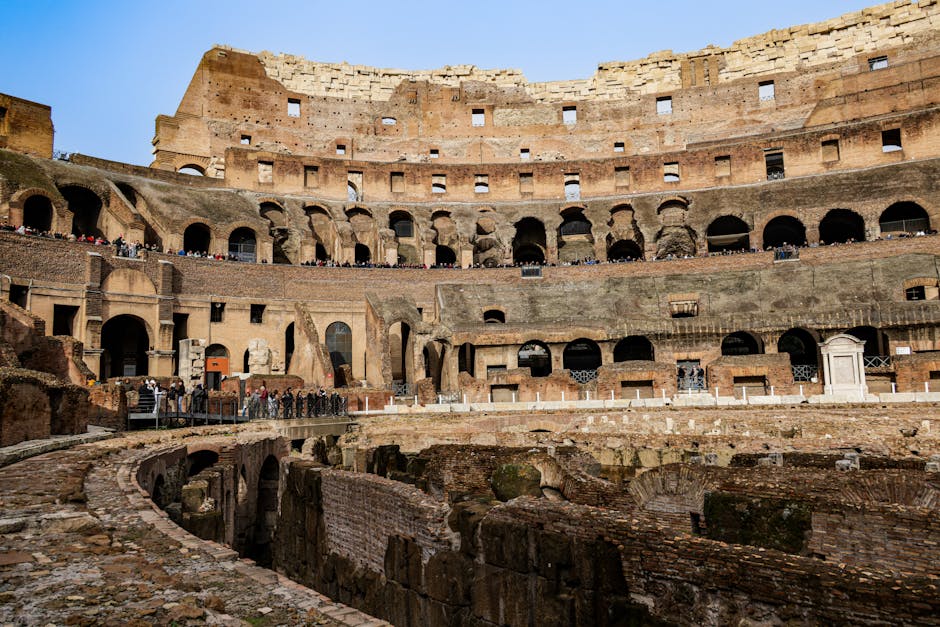
What visitors see today is actually the underground level, or hypogeum. The original arena floor was made of wood covered with sand and could be removed or reconfigured. The word "arena" itself comes from the Latin word for sand, "harena," which was used to absorb blood during contests.

5. Naval Battles Were Staged Inside the Colosseum

In the early years of the Colosseum's operation, the arena was flooded with water to stage spectacular naval battle reenactments called "naumachiae." These mock sea battles featured real ships and combat, though this practice was eventually discontinued as the complex underground systems were developed.

6. An Advanced Elevator System Operated Below Ground

The hypogeum contained an elaborate system of 28 lifts and 80 vertical shafts that could raise animals, gladiators, and scenery to the arena floor through trapdoors. This mechanical marvel allowed for dramatic surprise entrances and quick scene changes during performances, creating spectacular theatrical effects.

7. A Retractable Awning Covered the Seating Area

The Colosseum featured a massive retractable awning called the "velarium" that protected spectators from the sun and rain. This sophisticated fabric roof was supported by 240 wooden poles and required a team of approximately 100 sailors from the Roman naval headquarters to operate the complex rope and pulley system.

8. Wild Animals From Across the Empire Were Displayed

Exotic animals from every corner of the Roman Empire were brought to the Colosseum for hunting spectacles called "venationes." These included lions, tigers, elephants, bears, hippopotamuses, crocodiles, and even ostriches. Thousands of animals were killed during these events, contributing to the extinction or regional disappearance of several species.

9. The Inaugural Games Lasted 100 Days

When Emperor Titus officially opened the Colosseum in 80 AD, the celebration lasted an astonishing 100 consecutive days. During this period, approximately 9,000 animals were killed, and hundreds of gladiators fought in combat. The spectacle included elaborate hunts, executions, and gladiatorial contests.

10. Gladiator Fights Were Not Always to the Death

Contrary to popular belief, many gladiatorial contests did not end in death. Trained gladiators were valuable assets, and their managers often ensured their survival. Matches could be stopped by referees, and defeated gladiators could appeal for mercy. The mortality rate varied depending on the type of contest and historical period.

11. Christians May Not Have Been Martyred There

While tradition holds that early Christians were martyred in the Colosseum, there is no definitive historical evidence to support this claim. Executions certainly took place in the arena, but specific documentation linking Christian martyrdom to the Colosseum remains elusive among historians.

12. The Structure Survived Multiple Earthquakes

The Colosseum has endured several major earthquakes throughout its history, with significant damage occurring in 847 AD and 1349 AD. The southern exterior wall collapsed during the 1349 earthquake, and much of this fallen stone was subsequently recycled for other building projects around Rome.

13. It Served as a Quarry for Renaissance Buildings

During the Middle Ages and Renaissance, the Colosseum became a source of building materials for other Roman structures. Marble, stone, and iron clamps were stripped from the monument and used in the construction of St. Peter's Basilica, Palazzo Venezia, and other notable buildings throughout Rome.

14. Wealthy Families Once Occupied the Structure

After falling into disuse as an entertainment venue, the Colosseum was transformed into a residential and commercial space. The prominent Frangipani family fortified and occupied portions of the structure during the medieval period, while other sections housed workshops, religious quarters, and even a cemetery.

15. The Underground Tunnels Extended Beyond the Arena

The hypogeum's tunnel system actually connected to nearby gladiator training schools and animal enclosures outside the Colosseum. This allowed fighters and beasts to be transported to the arena without passing through the crowds, maintaining the element of surprise for spectators.

16. Modern Sports Stadiums Copy Its Design

The Colosseum's architectural influence is evident in contemporary sports stadiums worldwide. Its elliptical shape, tiered seating arrangement, and system of entrances and exits inspired modern venue design. Even the concept of numbered sections and passages for crowd management originated with this ancient structure.

17. The Building Used Revolutionary Concrete Technology

Roman concrete, made from volcanic ash, lime, and seawater, was crucial to the Colosseum's construction and longevity. This innovative material allowed Romans to create the massive arches and vaults that supported the structure. Remarkably, this ancient concrete has proven more durable than many modern formulations.

18. It Features Three Different Architectural Orders

The Colosseum's facade displays three classical architectural orders stacked vertically: Doric columns on the ground floor, Ionic on the second level, and Corinthian on the third. This progression from the sturdiest to the most ornate style demonstrated Roman architectural sophistication and became a template for subsequent buildings.

19. The Monument Receives Millions of Visitors Annually

Today, the Colosseum is Italy's most popular tourist attraction, welcoming more than 7 million visitors each year. It generates significant revenue for Rome and provides employment for hundreds of people, proving that this ancient structure remains economically relevant two millennia after its construction.

20. The Structure Is Now a Symbol of Peace

In modern times, the Colosseum has been adopted as an international symbol against capital punishment. Since 2000, the monument has been illuminated with golden light for 48 hours whenever a death sentence is commuted anywhere in the world or when a jurisdiction abolishes capital punishment, transforming this former site of bloodshed into a beacon of human rights.

A Living Testament to History

The Colosseum's remarkable history extends far beyond its role as an ancient entertainment venue. From its innovative engineering and rapid construction to its transformation into a symbol of peace, these twenty facts reveal the monument's enduring significance. This architectural masterpiece not only showcases Roman ingenuity and ambition but continues to inspire and educate people worldwide, connecting us to a civilization that flourished two thousand years ago while remaining relevant to contemporary society.