









How many original colonies declared independence from Britain to form the United States?

1 / 10 Questions
0 Points

How many original colonies declared independence from Britain to form the United States?

15

12

13

10

Points won
0
Correct score
0%

More Questions

More Articles

American Geography Trivia: From US to Global Wonders

American Geography Trivia: From US to Global Wonders

⏱️ 5 min read

Geography encompasses far more than memorizing state capitals and country names. It represents a fascinating intersection of natural wonders, human development, and the intricate relationships between people and their environments. From the diverse landscapes of the United States to remarkable features across the globe, geographical knowledge opens windows into understanding our world's complexity and beauty.

The Vast Diversity of American Landscapes

The United States spans approximately 3.8 million square miles, making it the third-largest country by total area. This immense territory contains virtually every type of ecosystem imaginable, from arctic tundra in Alaska to tropical environments in Hawaii and Florida. The country's geographical diversity is one of its defining characteristics, offering everything from deserts and mountains to prairies and coastlines.

The Continental Divide runs along the Rocky Mountains, determining whether rivers flow toward the Pacific Ocean or the Atlantic Ocean and Gulf of Mexico. This geographical feature plays a crucial role in the nation's water distribution, weather patterns, and ecological systems. Meanwhile, the Mississippi River system, stretching over 2,300 miles, drains roughly 40 percent of the continental United States, making it one of the world's most significant river networks.

Remarkable American Geographical Extremes

The United States holds numerous geographical superlatives that often surprise even well-informed individuals. Death Valley, California, recorded the highest reliable temperature ever measured on Earth at 134°F (56.7°C) in July 1913. This same location sits at 282 feet below sea level, making it the lowest point in North America. Contrastingly, Alaska's Denali rises to 20,310 feet, claiming the title of North America's highest peak.

The Great Lakes collectively contain approximately 21 percent of the world's surface fresh water, with Lake Superior being the largest freshwater lake by surface area globally. These five lakes—Superior, Michigan, Huron, Erie, and Ontario—create a distinctive geographical feature visible from space and significantly influence regional climate patterns, supporting millions of residents and diverse ecosystems.

Unique American Geographical Phenomena

Tornado Alley, stretching across the Great Plains from Texas to South Dakota, experiences more tornadoes than anywhere else on Earth. The flat terrain and unique atmospheric conditions create perfect circumstances for severe weather systems. Similarly, the Ring of Fire volcanic belt influences the West Coast, particularly affecting Alaska, Washington, Oregon, and California with seismic and volcanic activity.

The Four Corners region represents the only point in the United States where four states—Arizona, Colorado, New Mexico, and Utah—meet at a single point. This unique geographical feature has become a popular tourist destination and holds significant cultural importance for Native American tribes in the region.

American Territorial Reach Beyond the Mainland

The United States maintains sovereignty over numerous territories extending far beyond the continental states. These include:

  • Puerto Rico in the Caribbean, home to approximately 3.2 million residents
  • Guam and the Northern Mariana Islands in the western Pacific Ocean
  • American Samoa in the South Pacific
  • The U.S. Virgin Islands in the Caribbean Sea
  • Various uninhabited territories and atolls scattered across the Pacific

These territories expand American geographical influence across multiple time zones and hemispheres, contributing to the nation's strategic, economic, and cultural presence worldwide.

Connecting American Geography to Global Wonders

Understanding American geography provides context for appreciating remarkable geographical features worldwide. The Grand Canyon, while impressive at 277 miles long and up to 18 miles wide, invites comparison with other extraordinary canyons like Peru's Cotahuasi Canyon or Tibet's Yarlung Tsangpo Grand Canyon, both of which exceed the Grand Canyon in depth.

The concept of biodiversity hotspots connects American ecosystems with global conservation priorities. While the California Floristic Province represents a crucial biodiversity area in North America, it exists within a worldwide network of 36 recognized biodiversity hotspots, each supporting exceptional concentrations of endemic species facing significant threats.

Global Geographical Superlatives Worth Knowing

Expanding geographical knowledge beyond American borders reveals fascinating global extremes. Mount Everest reaches 29,032 feet above sea level, while the Mariana Trench plunges approximately 36,000 feet below the ocean surface. The Nile River traditionally held the title of world's longest river at approximately 4,130 miles, though some measurements suggest the Amazon River may actually exceed this length.

Russia remains the world's largest country by land area, spanning 11 time zones and covering more than 6.6 million square miles. Vatican City, conversely, occupies only 0.17 square miles, making it the smallest internationally recognized independent state. These extremes demonstrate the remarkable variety in how humans organize territorial boundaries.

The Importance of Geographical Literacy

Understanding geography extends beyond memorizing facts and figures. Geographical knowledge helps explain climate patterns, resource distribution, population movements, and geopolitical relationships. It provides context for understanding natural disasters, environmental challenges, and economic development patterns affecting communities worldwide.

Climate zones, topographical features, and water access fundamentally shape human civilization. The concentration of major cities along coastlines and rivers demonstrates geography's influence on settlement patterns throughout history. Similarly, mountain ranges, deserts, and oceans have historically served as natural barriers affecting cultural development, trade routes, and political boundaries.

As global interconnectedness increases, geographical literacy becomes increasingly valuable for understanding international relations, environmental challenges, and cultural diversity. Whether exploring American landscapes or studying distant continents, geographical knowledge enriches our comprehension of the complex, beautiful world we inhabit.
Did You Know These 12 Facts About the Arc de Triomphe?

Did You Know These 12 Facts About the Arc de Triomphe?

⏱️ 7 min read

Standing majestically at the center of the Place Charles de Gaulle in Paris, the Arc de Triomphe is one of the world's most recognizable monuments. While millions of tourists photograph this iconic landmark each year, many fascinating details about its history, construction, and significance remain relatively unknown. From its Napoleonic origins to its modern-day role in French national ceremonies, the Arc de Triomphe holds secrets that even frequent visitors might not know.

Remarkable Facts About Paris's Iconic Monument

1. Napoleon Never Saw It Completed

Emperor Napoleon Bonaparte commissioned the Arc de Triomphe in 1806 to honor the Grande Armée and celebrate his victory at the Battle of Austerlitz. However, construction took 30 years to complete, finishing in 1836. Napoleon died in exile in 1821, fifteen years before the monument's completion. Ironically, his remains did pass under the arch in 1840 when they were returned to France for reburial at Les Invalides. When Napoleon married his second wife, Marie-Louise of Austria, in 1810, only a wooden mock-up of the arch existed for the wedding procession.

2. It's the Second Largest Triumphal Arch in the World

The Arc de Triomphe measures an impressive 50 meters (164 feet) in height, 45 meters (148 feet) in width, and 22 meters (72 feet) in depth. Despite its monumental size, it ranks as the second largest triumphal arch globally. The largest is the Arch of Triumph in Pyongyang, North Korea, which was deliberately built to be slightly larger. The Parisian arch's massive scale was intentional, designed to dwarf other triumphal arches and symbolize the might of Napoleon's military achievements.

3. The Tomb of the Unknown Soldier Lies Beneath

Since November 11, 1920, the Arc de Triomphe has housed the Tomb of the Unknown Soldier from World War I. The eternal flame at the tomb, rekindled every evening at 6:30 PM, has never been extinguished since it was first lit on November 11, 1923. This daily ceremony honors all unidentified soldiers who died for France. The flame continued burning even during the German occupation of Paris in World War II, and German soldiers were actually ordered to respect and maintain the site.

4. Twelve Avenues Radiate from the Monument

The Arc de Triomphe stands at the center of Place Charles de Gaulle, formerly known as Place de l'Étoile (meaning "Star Square"). Twelve grand avenues radiate from the monument in a star pattern, including the famous Champs-Élysées. This urban planning masterpiece was designed by Baron Haussmann during his renovation of Paris in the 1850s and 1860s. The configuration creates one of the most complex traffic circles in the world, where cars entering the roundabout have the right of way—a unique exception to French traffic law.

5. Intricate Sculptural Details Tell Military Stories

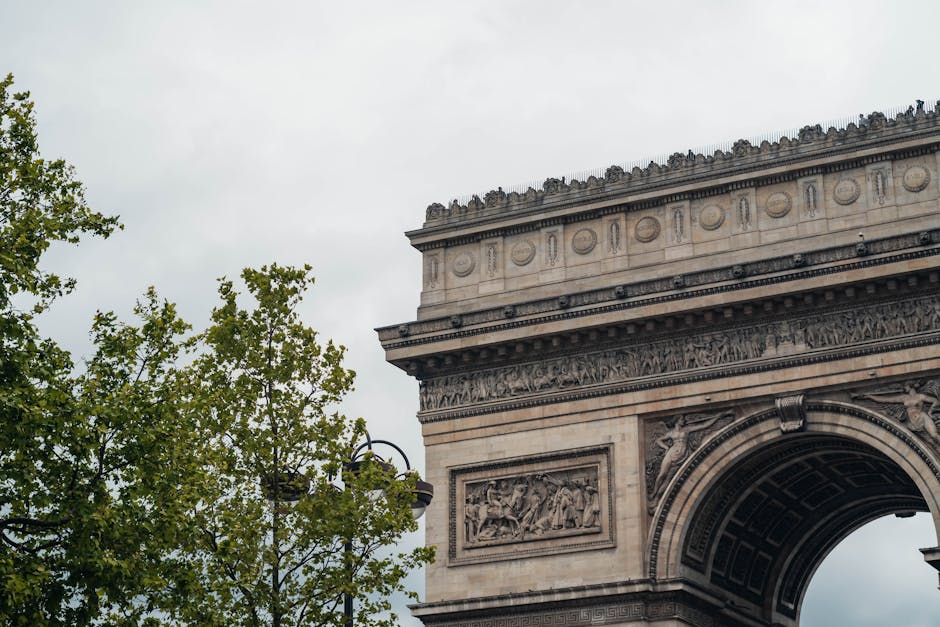
The monument features four massive sculptural groups at its base, each representing a significant moment in French military history. The most famous is "The Departure of the Volunteers of 1792," commonly known as "La Marseillaise," created by François Rude. The reliefs depict various battles and military triumphs from the Revolutionary and Napoleonic periods. Additionally, the interior walls are engraved with the names of 558 French generals, with those who died in battle underlined. The surfaces also list 128 battles fought between 1792 and 1815.

6. A Daring Aerial Stunt Made History

On August 7, 1919, pilot Charles Godefroy flew his Nieuport biplane through the Arc de Triomphe. This unauthorized flight was performed to honor French pilots who had died during World War I and whose efforts Godefroy felt were insufficiently recognized during the Victory Parade. The wingspan of his aircraft was only about 30 feet, leaving minimal clearance on either side of the arch's 48-foot-wide opening. No photographs exist of the actual flight, but a cameraman filmed the event, providing the only documentation of this remarkable feat.

7. Viewing Platform Offers Unparalleled Parisian Vistas

Visitors can climb 284 steps to reach the observation deck at the top of the Arc de Triomphe, which provides one of the most spectacular views of Paris. From this vantage point, all twelve avenues radiating from the monument are visible, along with landmarks including the Eiffel Tower, Sacré-Cœur, and the modern Grande Arche de la Défense, which was deliberately aligned with the Arc de Triomphe. The interior also houses a small museum dedicated to the monument's history and the significance of French triumphal arches.

8. The Foundation Took Two Years to Complete

Construction of the Arc de Triomphe began in 1806, but workers spent the first two years solely on the foundation. The unstable ground at the Chaillot hill location required extensive underground work to ensure the massive structure would remain stable. Engineer Jean-Arnaud Raymond designed the foundation system, which had to support approximately 100,000 tons of stone. This meticulous groundwork proved successful, as the monument has stood firm for nearly two centuries despite its enormous weight and Paris's clay-rich soil.

9. Hitler's Visit Changed World War II Symbolism

Adolf Hitler visited the Arc de Triomphe on June 23, 1940, during his only tour of conquered Paris. He laid a wreath at the Tomb of the Unknown Soldier, a gesture that was photographed and publicized. However, this moment later became symbolic of French resistance when General Charles de Gaulle led the Liberation of Paris parade down the Champs-Élysées and past the Arc on August 26, 1944. De Gaulle's famous walk reclaimed the monument as a symbol of French freedom and resilience.

10. The Arch's Surface Contains Hidden Messages

The shield at the top of the monument bears the inscription "Here lies a French soldier who died for his country 1914-1918." Less visible are numerous other inscriptions throughout the structure. The inner walls feature patriotic phrases and dedications, while the attic contains a list of major Revolutionary and Napoleonic victories. Some inscriptions were added at different times, creating a layered historical text that reflects changing French attitudes toward military glory and national identity over nearly two centuries.

11. Elaborate National Ceremonies Continue Today

The Arc de Triomphe remains central to French national ceremonies and commemorations. Every Bastille Day (July 14), the French President attends a ceremony at the tomb, and the annual military parade begins at the arch before proceeding down the Champs-Élysées. Veterans' organizations, foreign dignitaries, and visiting heads of state regularly lay wreaths at the Tomb of the Unknown Soldier. These continuing traditions maintain the monument's relevance as a living memorial rather than merely a historical artifact.

12. Recent Artistic Wrapping Created Global Sensation

In September 2021, the Arc de Triomphe was wrapped in 25,000 square meters of recyclable polypropylene fabric bound with red ropes, fulfilling a vision by artists Christo and Jeanne-Claude. Although Christo passed away in 2020, his team completed the installation, which was viewable for 16 days. This temporary artwork, titled "L'Arc de Triomphe, Wrapped," transformed the monument into a shimmering, silvery-blue sculptural object, attracting millions of visitors and generating worldwide attention. The project demonstrated how even centuries-old monuments can be reimagined through contemporary art.

Conclusion

The Arc de Triomphe stands as far more than an impressive architectural achievement. Its fascinating history encompasses military triumph and tragedy, daring aviation feats, wartime occupation and liberation, and continuing national significance. From Napoleon's unrealized vision to modern artistic interventions, the monument has evolved while maintaining its core purpose as a memorial to French military valor. Whether viewed as a historical landmark, an artistic canvas, or a living memorial, the Arc de Triomphe continues to captivate visitors with stories that extend far beyond its imposing stone facade. These twelve facts reveal just a portion of the rich narrative embedded in this Parisian icon, reminding us that even the most photographed landmarks hold secrets waiting to be discovered.