






What letter never appears in any U.S. state name?

1 / 10 Questions
0 Points

What letter never appears in any U.S. state name?

Z

J

Q

X

Points won
0
Correct score
0%

More Questions

More Articles

Did You Know? 20 Surprising Facts About the Colosseum

Did You Know? 20 Surprising Facts About the Colosseum

⏱️ 6 min read

The Colosseum stands as one of the most iconic landmarks of ancient Rome and continues to captivate millions of visitors each year. While many people recognize its distinctive silhouette, this architectural marvel holds countless secrets and surprising details that even history enthusiasts might not know. From its ingenious engineering to the dramatic spectacles that once filled its arena, the Colosseum's story is far more complex and fascinating than most imagine.

Remarkable Facts About Rome's Ancient Arena

1. The Original Name Was the Flavian Amphitheatre

The structure we know as the Colosseum was originally called the Amphitheatrum Flavium, or Flavian Amphitheatre, named after the dynasty of emperors who commissioned it. The name "Colosseum" likely came from a colossal statue of Emperor Nero that once stood nearby, measuring approximately 100 feet tall. This nickname didn't become commonly used until medieval times.

2. Construction Took Less Than a Decade

Despite its massive size and complexity, the Colosseum was completed in just eight years, from 72 AD to 80 AD. This remarkably swift construction was accomplished using an estimated 60,000 to 100,000 Jewish slaves captured during the First Jewish-Roman War, along with Roman engineers and professional craftsmen who worked tirelessly on the project.

3. It Could Hold More Than 50,000 Spectators

The Colosseum was designed to accommodate between 50,000 and 80,000 spectators, making it larger than most modern sports stadiums. The seating was strictly organized by social class, with the emperor and senators occupying the best seats closest to the action, while common citizens and women sat in the upper tiers.

4. The Arena Floor Was Completely Removable

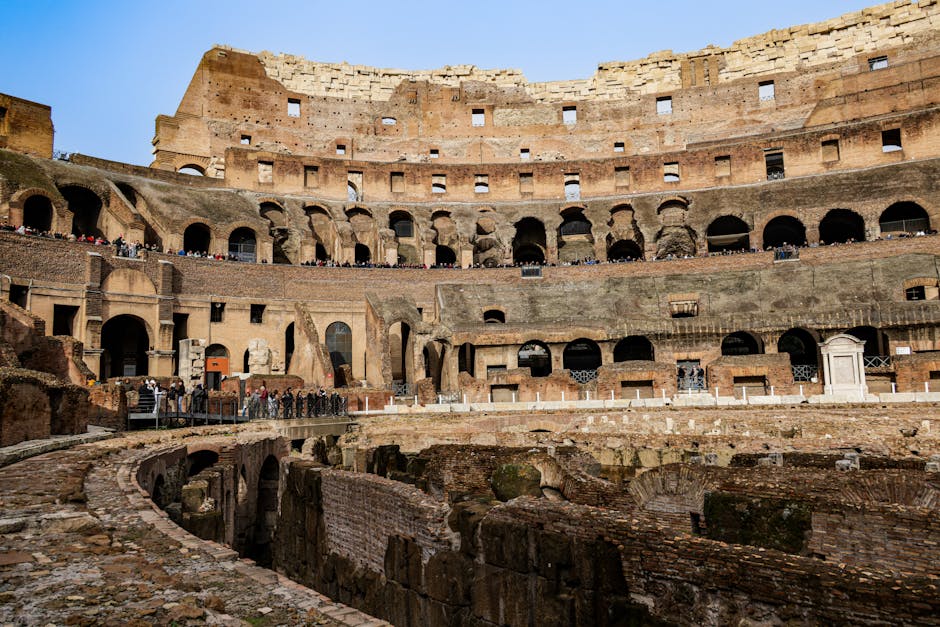
What visitors see today is actually the underground level, or hypogeum. The original arena floor was made of wood covered with sand and could be removed or reconfigured. The word "arena" itself comes from the Latin word for sand, "harena," which was used to absorb blood during contests.

5. Naval Battles Were Staged Inside the Colosseum

In the early years of the Colosseum's operation, the arena was flooded with water to stage spectacular naval battle reenactments called "naumachiae." These mock sea battles featured real ships and combat, though this practice was eventually discontinued as the complex underground systems were developed.

6. An Advanced Elevator System Operated Below Ground

The hypogeum contained an elaborate system of 28 lifts and 80 vertical shafts that could raise animals, gladiators, and scenery to the arena floor through trapdoors. This mechanical marvel allowed for dramatic surprise entrances and quick scene changes during performances, creating spectacular theatrical effects.

7. A Retractable Awning Covered the Seating Area

The Colosseum featured a massive retractable awning called the "velarium" that protected spectators from the sun and rain. This sophisticated fabric roof was supported by 240 wooden poles and required a team of approximately 100 sailors from the Roman naval headquarters to operate the complex rope and pulley system.

8. Wild Animals From Across the Empire Were Displayed

Exotic animals from every corner of the Roman Empire were brought to the Colosseum for hunting spectacles called "venationes." These included lions, tigers, elephants, bears, hippopotamuses, crocodiles, and even ostriches. Thousands of animals were killed during these events, contributing to the extinction or regional disappearance of several species.

9. The Inaugural Games Lasted 100 Days

When Emperor Titus officially opened the Colosseum in 80 AD, the celebration lasted an astonishing 100 consecutive days. During this period, approximately 9,000 animals were killed, and hundreds of gladiators fought in combat. The spectacle included elaborate hunts, executions, and gladiatorial contests.

10. Gladiator Fights Were Not Always to the Death

Contrary to popular belief, many gladiatorial contests did not end in death. Trained gladiators were valuable assets, and their managers often ensured their survival. Matches could be stopped by referees, and defeated gladiators could appeal for mercy. The mortality rate varied depending on the type of contest and historical period.

11. Christians May Not Have Been Martyred There

While tradition holds that early Christians were martyred in the Colosseum, there is no definitive historical evidence to support this claim. Executions certainly took place in the arena, but specific documentation linking Christian martyrdom to the Colosseum remains elusive among historians.

12. The Structure Survived Multiple Earthquakes

The Colosseum has endured several major earthquakes throughout its history, with significant damage occurring in 847 AD and 1349 AD. The southern exterior wall collapsed during the 1349 earthquake, and much of this fallen stone was subsequently recycled for other building projects around Rome.

13. It Served as a Quarry for Renaissance Buildings

During the Middle Ages and Renaissance, the Colosseum became a source of building materials for other Roman structures. Marble, stone, and iron clamps were stripped from the monument and used in the construction of St. Peter's Basilica, Palazzo Venezia, and other notable buildings throughout Rome.

14. Wealthy Families Once Occupied the Structure

After falling into disuse as an entertainment venue, the Colosseum was transformed into a residential and commercial space. The prominent Frangipani family fortified and occupied portions of the structure during the medieval period, while other sections housed workshops, religious quarters, and even a cemetery.

15. The Underground Tunnels Extended Beyond the Arena

The hypogeum's tunnel system actually connected to nearby gladiator training schools and animal enclosures outside the Colosseum. This allowed fighters and beasts to be transported to the arena without passing through the crowds, maintaining the element of surprise for spectators.

16. Modern Sports Stadiums Copy Its Design

The Colosseum's architectural influence is evident in contemporary sports stadiums worldwide. Its elliptical shape, tiered seating arrangement, and system of entrances and exits inspired modern venue design. Even the concept of numbered sections and passages for crowd management originated with this ancient structure.

17. The Building Used Revolutionary Concrete Technology

Roman concrete, made from volcanic ash, lime, and seawater, was crucial to the Colosseum's construction and longevity. This innovative material allowed Romans to create the massive arches and vaults that supported the structure. Remarkably, this ancient concrete has proven more durable than many modern formulations.

18. It Features Three Different Architectural Orders

The Colosseum's facade displays three classical architectural orders stacked vertically: Doric columns on the ground floor, Ionic on the second level, and Corinthian on the third. This progression from the sturdiest to the most ornate style demonstrated Roman architectural sophistication and became a template for subsequent buildings.

19. The Monument Receives Millions of Visitors Annually

Today, the Colosseum is Italy's most popular tourist attraction, welcoming more than 7 million visitors each year. It generates significant revenue for Rome and provides employment for hundreds of people, proving that this ancient structure remains economically relevant two millennia after its construction.

20. The Structure Is Now a Symbol of Peace

In modern times, the Colosseum has been adopted as an international symbol against capital punishment. Since 2000, the monument has been illuminated with golden light for 48 hours whenever a death sentence is commuted anywhere in the world or when a jurisdiction abolishes capital punishment, transforming this former site of bloodshed into a beacon of human rights.

A Living Testament to History

The Colosseum's remarkable history extends far beyond its role as an ancient entertainment venue. From its innovative engineering and rapid construction to its transformation into a symbol of peace, these twenty facts reveal the monument's enduring significance. This architectural masterpiece not only showcases Roman ingenuity and ambition but continues to inspire and educate people worldwide, connecting us to a civilization that flourished two thousand years ago while remaining relevant to contemporary society.
Top 10 Pivotal Moments in the Civil Rights Movement

Top 10 Pivotal Moments in the Civil Rights Movement

⏱️ 7 min read

The American Civil Rights Movement represents one of the most transformative periods in United States history, fundamentally reshaping the nation's social, legal, and political landscape. Through the courage of countless individuals who risked their lives for equality, the movement challenged systemic racism and dismantled institutionalized segregation. Understanding the key moments that defined this era provides crucial insight into how sustained activism and moral conviction can drive profound social change.

Landmark Events That Changed America

1. Brown v. Board of Education Supreme Court Decision (1954)

The unanimous Supreme Court ruling in Brown v. Board of Education struck down the "separate but equal" doctrine established by Plessy v. Ferguson in 1896. Chief Justice Earl Warren delivered the opinion that segregated schools were inherently unequal and violated the Fourteenth Amendment's Equal Protection Clause. This landmark decision didn't immediately desegregate schools across America, but it provided the legal foundation for challenging segregation in all public facilities. The case, brought by the NAACP on behalf of Linda Brown and other Black students, represented years of strategic legal planning and marked a turning point in using the judicial system to combat racial discrimination.

2. The Montgomery Bus Boycott (1955-1956)

When Rosa Parks refused to surrender her seat to a white passenger on December 1, 1955, her arrest sparked a 381-day boycott of Montgomery's bus system. The African American community, comprising approximately 75% of bus riders, organized carpools, walked miles to work, and endured economic hardship to protest segregated seating. Led by a young minister named Dr. Martin Luther King Jr., the boycott demonstrated the power of nonviolent resistance and economic pressure. The protest ended victoriously when the Supreme Court ruled that bus segregation was unconstitutional, establishing a blueprint for future civil rights campaigns and catapulting King into national prominence.

3. The Little Rock Nine Crisis (1957)

The integration of Little Rock Central High School became a dramatic confrontation between state and federal authority. When nine Black students attempted to attend the previously all-white school, Arkansas Governor Orval Faubus deployed the National Guard to prevent their entry. The images of Elizabeth Eckford being harassed by angry mobs shocked the nation and the world. President Dwight Eisenhower ultimately federalized the Arkansas National Guard and sent the 101st Airborne Division to escort and protect the students. This moment demonstrated that the federal government would enforce desegregation orders, though the students endured a year of relentless harassment and intimidation.

4. The Greensboro Sit-Ins (1960)

Four African American college students—Ezell Blair Jr., David Richmond, Franklin McCain, and Joseph McNeil—sat at a segregated Woolworth's lunch counter in Greensboro, North Carolina, on February 1, 1960, and politely requested service. When refused, they remained seated until closing. This simple act of defiance inspired a wave of sit-ins across the South, with thousands of students, both Black and white, participating in similar protests. The sit-in movement revitalized the Civil Rights Movement by engaging young people directly and demonstrating that ordinary citizens could challenge injustice through peaceful but disruptive action. The protests led to the desegregation of lunch counters in numerous cities and helped establish the Student Nonviolent Coordinating Committee (SNCC).

5. The Freedom Rides (1961)

Despite Supreme Court rulings declaring segregation on interstate buses and in terminal facilities unconstitutional, many Southern states continued these practices. The Congress of Racial Equality (CORE) organized Freedom Rides, sending integrated groups of activists on buses through the South to challenge segregation. The riders faced brutal violence, including a firebombing outside Anniston, Alabama, and savage beatings in Birmingham and Montgomery. The Kennedy administration, initially reluctant to intervene, eventually pressured the Interstate Commerce Commission to enforce desegregation regulations. The Freedom Rides demonstrated both the depth of Southern resistance and the determination of civil rights activists to force federal action.

6. The March on Washington (1963)

On August 28, 1963, approximately 250,000 people gathered at the Lincoln Memorial in the largest demonstration for civil rights in American history. The peaceful march brought together diverse groups demanding jobs, freedom, and an end to segregation. Dr. Martin Luther King Jr. delivered his iconic "I Have a Dream" speech, articulating a vision of racial harmony that resonated globally. The march demonstrated the movement's broad support, including significant white participation, and created political momentum for civil rights legislation. The event showcased disciplined, peaceful protest and presented the movement's goals to a national television audience, countering stereotypes and building public support.

7. The Birmingham Campaign (1963)

The strategic protests in Birmingham, Alabama—one of the South's most segregated cities—deliberately provoked a crisis that would demand federal intervention. Dr. King and the Southern Christian Leadership Conference (SCLC) organized demonstrations, boycotts, and sit-ins. Public Safety Commissioner Bull Connor responded with police dogs, high-pressure fire hoses, and mass arrests, including children. The shocking images broadcast worldwide generated sympathy for the movement and pressure on the Kennedy administration. The campaign resulted in the desegregation of Birmingham's downtown businesses and demonstrated that nonviolent resistance could succeed even in the most hostile environments.

8. The Civil Rights Act of 1964

President Lyndon B. Johnson signed the Civil Rights Act into law on July 2, 1964, creating the most comprehensive civil rights legislation since Reconstruction. The act prohibited discrimination based on race, color, religion, sex, or national origin in public accommodations, employment, and federally funded programs. It established the Equal Employment Opportunity Commission and gave the federal government tools to enforce desegregation. Though initially proposed by President Kennedy before his assassination, Johnson used his legislative skills to overcome fierce Southern opposition. This landmark legislation transformed American society by legally dismantling segregation and providing mechanisms for addressing discrimination.

9. The Selma to Montgomery Marches (1965)

Voting rights activists organized a march from Selma to Montgomery, Alabama, to protest discriminatory voting practices that effectively disenfranchised Black citizens. On March 7, 1965—"Bloody Sunday"—state troopers and local police attacked peaceful marchers with clubs and tear gas at the Edmund Pettus Bridge. The televised brutality shocked Americans and generated support for voting rights legislation. After federal court approval and protection from federalized National Guard troops, the march successfully reached Montgomery on March 25. The Selma marches directly led to the Voting Rights Act and demonstrated that systematic violence against peaceful protesters could backfire politically.

10. The Voting Rights Act of 1965

Signed by President Johnson on August 6, 1965, the Voting Rights Act eliminated literacy tests, poll taxes, and other barriers used to prevent African Americans from voting. The act provided for federal oversight of elections in jurisdictions with histories of discrimination and authorized the Attorney General to send federal examiners to register voters. Within years, Black voter registration in the South increased dramatically, fundamentally altering Southern politics. This legislation represented the culmination of decades of struggle and sacrifice, transforming the promise of the Fifteenth Amendment into reality. The act remains one of the most effective civil rights laws ever enacted, though recent Supreme Court decisions have weakened some of its provisions.

The Enduring Legacy

These ten pivotal moments represent only a fraction of the countless acts of courage that defined the Civil Rights Movement. From Supreme Court decisions to grassroots protests, from legislative victories to personal sacrifices, each moment built upon previous efforts and inspired future action. The movement succeeded through strategic planning, moral clarity, and the willingness of ordinary people to risk everything for justice. While significant progress was achieved, the struggle for racial equality continues, making understanding these historical moments essential for addressing contemporary challenges. The Civil Rights Movement demonstrates that social change requires sustained effort, coalition-building, and unwavering commitment to principle, offering timeless lessons for those working toward a more just society.