








What unique ability do octopuses have?

1 / 10 Questions
0 Points
Points won
0
Correct score
0%

More Questions

More Articles

Global Geography Trivia: 20 Facts About Forests

Global Geography Trivia: 20 Facts About Forests

⏱️ 4 min read

Global Geography Trivia: 20 Facts About Forests

Forests are among Earth's most vital ecosystems, covering approximately 31% of the global land surface. These complex biological systems play crucial roles in climate regulation, biodiversity conservation, and human survival. Here are 20 fascinating geographical facts about forests around the world.

1. Amazon Rainforest Dominance

The Amazon rainforest is the world's largest tropical forest, covering approximately 5.5 million square kilometers across nine countries in South America, with Brazil containing about 60% of the forest.

2. Russian Taiga Expanse

The Russian Taiga is the world's largest forest by area, stretching across Siberia and constituting roughly 29% of the world's forest cover. It represents the largest contiguous forested area on Earth.

3. Congo Basin Significance

Africa's Congo Basin is the second-largest tropical rainforest globally, spanning six countries and covering about 3.3 million square kilometers. It hosts approximately 10,000 species of tropical plants.

4. Ancient Daintree Forest

Australia's Daintree Rainforest is the oldest continuously surviving tropical rainforest in the world, estimated to be around 180 million years old, predating the Amazon rainforest by millions of years.

5. Forestry Champions

Finland has the highest percentage of forest cover in Europe, with approximately 74% of its land area covered by forests. Globally, Suriname leads with about 98% forest coverage.

6. Deforestation Statistics

The Earth loses approximately 137 species of plants, animals, and insects every day due to rainforest deforestation, equating to 50,000 species annually.

7. Tongass National Forest

The Tongass National Forest in Alaska is the largest national forest in the United States, covering 16.7 million acres and representing the world's largest intact temperate rainforest.

8. Mangrove Distribution

Indonesia possesses the world's largest mangrove forest area, accounting for 23% of global mangrove forests, crucial for coastal protection and marine ecosystems.

9. Forest Carbon Storage

The world's forests store approximately 662 billion tons of carbon, with tropical forests storing about 47% of global forest carbon.

10. Mediterranean Forest Belt

Mediterranean forests form a unique ecological region spanning three continents, characterized by drought-resistant vegetation and high biodiversity levels.

11. Bamboo Forest Facts

China contains the world's largest bamboo forests, covering over 6 million hectares, representing about 40% of global bamboo forest area.

12. Cloud Forest Locations

Cloud forests occur in tropical or subtropical mountainous environments, with Costa Rica's Monteverde Cloud Forest Reserve being one of the most famous examples.

13. Boreal Forest Range

Boreal forests form a circumglobal band in the northern hemisphere, covering about 17% of Earth's land surface across Canada, Alaska, Russia, and Scandinavia.

14. Forest Biodiversity Hotspots

The forests of Borneo contain over 15,000 known plant species, with new species still being discovered regularly, making it one of Earth's richest biodiversity hotspots.

15. Sacred Forest Protection

India's sacred groves, protected by religious and cultural beliefs, represent some of the last remaining patches of primary forest in many regions, preserving unique biodiversity.

16. Temperate Rainforest Distribution

Temperate rainforests occur in only seven regions globally, including the Pacific Northwest, Chile, New Zealand, and Tasmania.

17. Forest Recovery Rates

A tropical forest typically takes 20-25 years to recover 80% of its biodiversity after selective logging, while full recovery can take centuries.

18. European Forest Growth

Despite common perception, European forest cover has increased by 9% since 1990, with an average of 643,000 hectares added annually.

19. Japanese Forest Management

Japan maintains approximately 67% forest cover through strict management practices, including the ancient sustainable forestry technique called "Satoyama."

20. Forest Ecosystem Services

Global forests provide ecosystem services worth an estimated $33 trillion annually, including water filtration, carbon sequestration, and soil protection.

Conclusion

These 20 facts highlight the incredible diversity, importance, and geographic distribution of the world's forests. From the ancient Daintree to the vast taiga, forests continue to play vital roles in Earth's ecological systems, climate regulation, and human societies. Understanding these facts helps emphasize the critical importance of forest conservation and sustainable management for future generations.
Did You Know? 12 Surprising Facts About Niagara Falls

Did You Know? 12 Surprising Facts About Niagara Falls

⏱️ 6 min read

Niagara Falls stands as one of North America's most iconic natural wonders, attracting millions of visitors annually to witness its thundering cascades. While most people recognize its breathtaking beauty, few realize the fascinating stories, remarkable statistics, and surprising historical events surrounding this magnificent landmark. From daredevil stunts to geological mysteries, these lesser-known facts reveal the incredible depth of Niagara Falls' significance.

Remarkable Discoveries About This Natural Wonder

1. Three Waterfalls Form the Niagara Complex

Contrary to popular belief, Niagara Falls isn't a single waterfall but actually comprises three distinct falls. The Horseshoe Falls, located primarily on the Canadian side, is the largest and most powerful. The American Falls and the smaller Bridal Veil Falls both flow on the United States side. Together, these three cascades create the spectacular display that has captivated observers for centuries. The Horseshoe Falls alone spans approximately 2,600 feet in width and accounts for roughly 90% of the water flow.

2. The Falls Are Relatively Young Geological Features

While Niagara Falls appears timeless, it's actually a geological infant. Scientists estimate the falls formed approximately 12,000 years ago at the end of the last ice age. As massive glaciers retreated, they released enormous volumes of meltwater that carved out the Niagara River and created the falls. This makes Niagara Falls significantly younger than many other major geological formations around the world.

3. The Falls Are Slowly Moving Backward

Erosion continuously reshapes Niagara Falls, causing them to gradually retreat upstream. Historically, the falls eroded at a rate of approximately three feet per year. However, thanks to modern water diversion and erosion control efforts, this rate has slowed dramatically to just one foot every ten years. Over the past 12,000 years, the falls have moved about seven miles upstream from their original location at the Niagara Escarpment.

4. Engineers Turned Off the American Falls in 1969

In one of the most ambitious engineering projects of the 20th century, the U.S. Army Corps of Engineers temporarily "dewatered" the American Falls for several months in 1969. They built a massive cofferdam consisting of 27,800 tons of rock to redirect water flow entirely to the Horseshoe Falls. This allowed geologists to study the rock face and remove unstable boulders. Thousands of tourists flocked to witness the rare sight of the exposed riverbed, discovering old coins and even human remains.

5. More Than Three Million Gallons Flow Every Second

The sheer volume of water cascading over Niagara Falls is staggering. During peak daytime tourist hours in the summer, approximately 750,000 gallons of water thunder over the falls every second. However, during nighttime and off-season periods when tourist demand is lower, water is diverted for hydroelectric power generation, reducing the flow to roughly 50,000 gallons per second. At maximum capacity, the falls can handle over six million cubic feet of water per minute.

6. Daredevils Have Challenged the Falls Since 1829

Niagara Falls has attracted numerous thrill-seekers attempting death-defying stunts. In 1829, Sam Patch became the first known person to survive a jump into the falls. The first person to go over the falls in a barrel and survive was 63-year-old schoolteacher Annie Edson Taylor in 1901. Since then, numerous daredevils have attempted the feat using various contraptions, though many stunts ended tragically. Today, such attempts are illegal on both the American and Canadian sides.

7. The Falls Completely Froze Over Multiple Times

While ice formations at Niagara Falls are common during winter, the falls have completely frozen solid on rare occasions. The most famous freeze occurred in March 1848, when an ice jam upriver completely stopped water flow for approximately 30 hours. More recently, in the brutal winter of 1911-1912, an enormous ice bridge formed that was thick enough for people to walk on. Extremely cold conditions in 2014 and 2015 also produced spectacular frozen formations, though the water never stopped flowing completely.

8. Nikola Tesla's Power Plant Revolutionized Electricity

Niagara Falls played a crucial role in the development of modern electrical power systems. In 1896, the first major hydroelectric power plant began operation, using Nikola Tesla's alternating current (AC) system. This groundbreaking facility demonstrated that electricity could be generated and transmitted over long distances efficiently. The power generated at Niagara Falls helped electrify Buffalo, New York, becoming one of the first cities in the world to have widespread electric power.

9. The Maid of the Mist Has Operated Since 1846

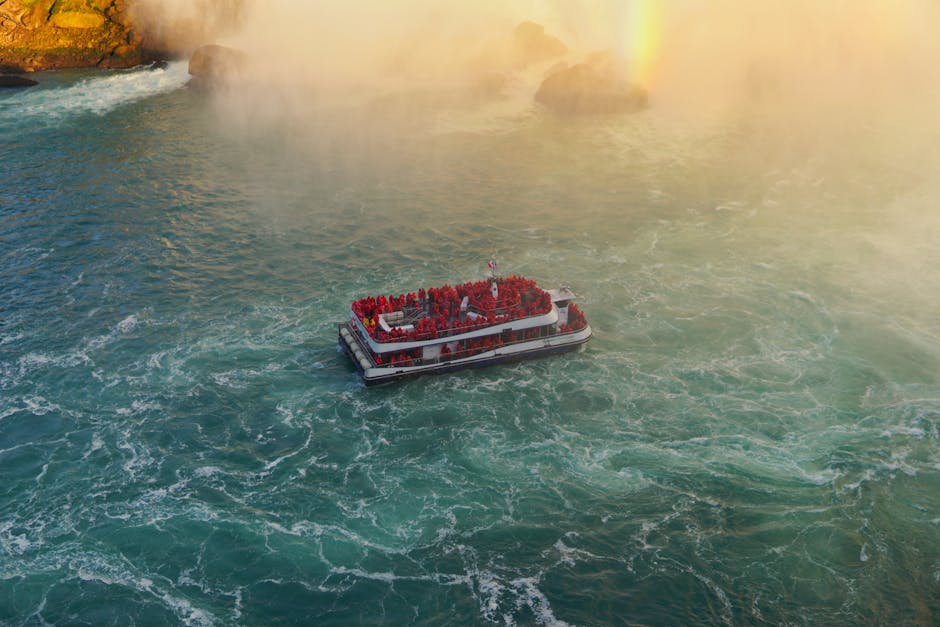
The famous Maid of the Mist boat tours have been operating for over 175 years, making them one of the oldest tourist attractions in North America. The name comes from an ancient Ongiara legend about a maiden sacrificed to the thunder god who lived in a cave behind the falls. These boats take visitors remarkably close to the base of the Horseshoe Falls, where passengers experience the tremendous power and mist that gives the tour its name.

10. A Seven-Year-Old Boy Survived Going Over the Falls

In one of the most miraculous survival stories, seven-year-old Roger Woodward accidentally went over the Horseshoe Falls in 1960 wearing only a life jacket. He was boating with his sister and a family friend when their boat capsized in the upper rapids. While his sister was rescued just before going over the edge, Roger plummeted over the 167-foot drop and incredibly survived with only minor injuries. He remains the youngest person to survive going over the falls.

11. The Falls Serve as an International Border

Niagara Falls uniquely straddles the international boundary between the United States and Canada. The border runs through the middle of the Niagara River and directly through the Horseshoe Falls. This geographical position has made the falls an important diplomatic and strategic location throughout history. Both countries have worked together to preserve the falls and manage water resources while maintaining their respective tourism industries.

12. Fish Can Actually Survive the Plunge

Remarkably, fish regularly go over Niagara Falls and survive the experience. Studies have shown that approximately 90% of fish that flow over the falls survive the plunge. The aerated water at the base of the falls creates a cushioning effect that protects the fish from the impact. Lake sturgeon, eels, and various other species routinely make this journey, though the survival rate is significantly higher at the Horseshoe Falls compared to the American Falls due to the deeper pool at its base.

A Natural Wonder Full of Surprises

These twelve surprising facts demonstrate that Niagara Falls is far more than just a beautiful tourist destination. From its geological youth and continuous evolution to its role in electrical power development and the incredible human stories associated with it, the falls represent a fascinating intersection of natural history, human ambition, and scientific achievement. Whether it's the massive water flow, the daring stunts, or the engineering marvels surrounding it, Niagara Falls continues to captivate and surprise those who take the time to learn about its remarkable characteristics. This natural wonder remains a testament to the awesome power of nature and humanity's enduring fascination with one of Earth's most spectacular displays.